- Key Takeaways
- What is Moxibustion?
- What is Acupuncture?
- Moxibustion vs Acupuncture: Key Differences at a Glance
- TCM Theory: How Your Body Constitution Guides Treatment
- Moxibustion Benefits: What Can It Treat?
- Why TCM Often Combines Both Moxibustion & Acupuncture
- What to Expect: Your First TCM Session
- Is Moxibustion TCM Safe? Risks and Contraindications
- Frequently Asked Questions
Your back has been aching for weeks. Your colleague swears by acupuncture, while your mother says try moxibustion. And somewhere between the two, you’re not sure which one is actually meant for you.
We know the feeling. Nuo ER TCM has been in the industry for almost 10 years, and it’s one of the most common questions our first-time patients ask.
Honestly, it depends on your body, your pattern, and what’s driving your symptoms. Both moxibustion TCM and acupuncture work along the same meridians and influence the flow of qi, but they treat the body through completely different mechanisms.
Choosing the right one (or the right combination) is the difference between managing a symptom and resolving its root cause. This guide breaks it all down.
Key Takeaways
- Moxibustion involves burning dried mugwort on or near acupuncture points, while acupuncture uses fine needles. Both restore balance and promote natural healing through the same meridian system.
- TCM practitioners select treatment based on your pattern: Deficient/Cold → Moxibustion; Excess/Stagnant/Hot → Acupuncture.
- Your TCM body constitution, assessed through pulse and tongue diagnosis, determines which therapy is right for you.
- Zhen Jiu (针灸), the classical Chinese term for the combined practice of acupuncture and moxibustion, literally integrates both: 针 (zhēn, needle) and 灸 (jiǔ, moxibustion).
- All TCM treatments in Singapore must be performed by practitioners registered with the TCM Practitioners Board under the Ministry of Health.
What is Moxibustion?
Moxibustion is one of the oldest therapies in Chinese medicine, and dates back to the Yin Dynasty (1600–1046 BC). Then, the Huangdi Neijing (compiled c. 475 BC–220 AD) later formalised the meridian framework underpinning both moxibustion and acupuncture.
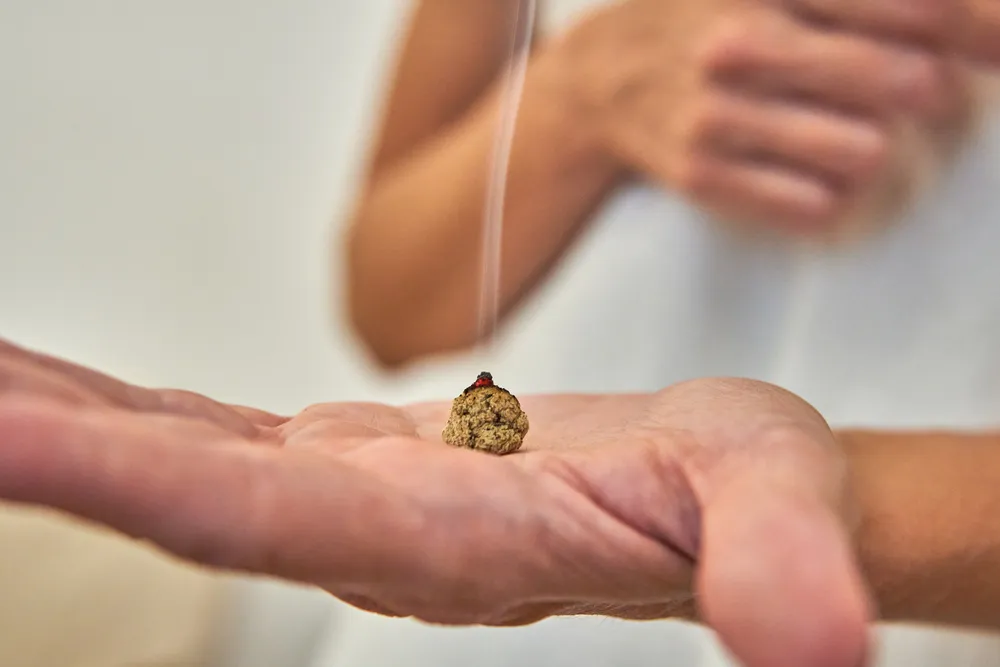
The practice involves burning moxa, a dried herb made from mugwort (Ai Ye), on or near specific acupuncture points to stimulate the flow of qi (energy).
According to TCM principles, mugwort is traditionally believed to promote blood circulation, dispel cold from internal organs, support Yuan Qi (the body’s foundational energy), and stimulate the movement of qi and blood to remove stagnation and stasis.
Three main techniques are used in clinical practice:
- Direct moxibustion: A cone of dried mugwort is placed directly on the skin at an acupuncture point. In non-scarring direct moxibustion, the cone is removed before it burns the skin. In scarring direct moxibustion, the cone is allowed to burn down, intentionally producing a therapeutic scar or blister. The non-scarring method is more commonly practised in Singapore today.
- Indirect moxibustion: A moxa stick is held near the skin without direct contact, or moxa is placed on acupuncture needles inserted into the skin, allowing heat to radiate into the point. This is the most common technique in Singapore clinics today.
- Warm Needle Acupuncture: Moxa is fixed to the handle of an inserted needle and lit, transferring heat directly into the acupoint. This technique is particularly effective for conditions like knee osteoarthritis and cold-stagnant digestive issues. Many clinics also offer smokeless moxa for patients with respiratory sensitivities.
What is Acupuncture?
Acupuncture is a cornerstone of traditional Chinese medicine TCM, involving the insertion of fine acupuncture needles into specific points along the body’s meridians to regulate the flow of qi and blood.
In Chinese medicine theory, the body’s vital energy, Qi, flows through energetic channels called meridians (12 regular and 8 extraordinary meridians), and any blockage or imbalance along these pathways can lead to illness.
Research suggests: Acupuncture, at its essence, helps with stress, anxiety, and depression by balancing the autonomic nervous system, delivering pain relief, reducing inflammation, and supporting overall health.
Moxibustion vs Acupuncture: Key Differences at a Glance
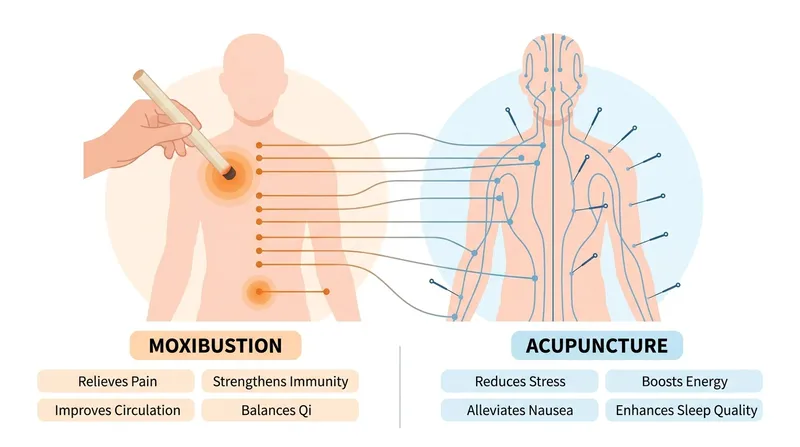
| Feature | Moxibustion | Acupuncture |
| Method | Burning dried mugwort (moxa stick or cone) on/near skin | Insertion of fine acupuncture needles into specific points |
| Mechanism | Warms meridians, improves blood flow via heat; supports Yuan Qi | Stimulates qi flow and the autonomic nervous system via needle pressure |
| Best for | Cold/Deficient conditions, fatigue, fertility, digestive issues | Pain relief, Excess/Stagnant/Hot patterns, stress, headaches |
| Sensation | Gentle penetrating warmth | Mild tingling, pressure, or numbness |
| Needle-free? | Yes — suitable for needle-averse patients | No |
| Pregnant women | Used with caution; certain points must be avoided | Used with caution under TCMPB guidance |
| Can they be used together? | Yes — acupuncture and moxibustion can be used separately or together in the treatment of disease |
TCM Theory: How Your Body Constitution Guides Treatment
The basic theory of acupuncture and moxibustion is underpinned by the meridians and collaterals, the pathways through which Qi and blood circulate.
A registered practitioner assesses your body constitution through pulse and tongue diagnosis before recommending any treatment. This determines whether your condition is:
- Deficient/Cold → Moxibustion therapy is primary. Heat disperses cold, warms Yang, and restores circulation.
- Excess/Stagnant → Acupuncture is primary, targeting specific points to move blocked Qi and blood.
- Mixed patterns → Both therapies are combined, often with herbal medicine as a third supporting layer.
This is the true foundation of a holistic approach in Traditional Chinese Medicine (TCM): treating the root cause, not just the symptoms.
Moxibustion Benefits: What Can It Treat?
Moxibustion therapy has strong effects for warming acupuncture points, dispelling cold, and stimulating the movement of Qi and blood.
Research confirms that moxibustion increases blood flow to tissues, supports the body’s natural immune and hormonal regulation, and stimulates healthy gut motility.
Its moxibustion benefits span a wide range of health conditions:
- Muscle pain, especially in the shoulders and knees
- Chronic joint pain and arthritis
- Fertility support (Findings are promising, but evidence quality varies across studies; results should be discussed with a qualified TCM physician)
- Breech baby positioning
- Menstrual irregularities and cramps
- Digestive issues
- Immunity (Wei Qi)
- Fatigue and energy
- Postpartum recovery
Why TCM Often Combines Both Moxibustion & Acupuncture
In Chinese medicine, TCM, acupuncture, and moxibustion are often combined (Zhen Jiu) to balance the body’s energy and blood. The combination is not incidental but structural.
Together, acupuncture and moxibustion address both symptoms (such as pain) and underlying causes (cold, stagnant Qi, and weak Yang) simultaneously. Moxibustion can increase circulation and reduce inflammation in the areas where acupuncture needles are inserted, while acupuncture provides precise meridian stimulation that moxa alone cannot.
Moxibustion is also used in conjunction with herbal medicine to prolong and deepen therapeutic effects. For example, a patient with fatigue, poor circulation, and digestive issues may receive acupuncture on the Stomach meridian, moxibustion on the navel and lower back, and an herbal formula to tonify Qi.
There’s also a 2025 meta-analysis that confirms the superiority of the combination of moxibustion and acupuncture over acupuncture alone for knee osteoarthritis, supporting what TCM practitioners have long practised.
What to Expect: Your First TCM Session
Step 1 — Consultation. Your practitioner takes your pulse, examines your tongue, and reviews your health history to identify your body constitution and pattern.
Step 2 — Treatment plan. Based on your assessment, the practitioner recommends moxibustion therapy, acupuncture, or a combination — along with herbal medicine if needed.
Step 3 — The session. You lie comfortably while acupuncture needles are placed and/or indirect moxibustion is applied. Expect a pleasant, deep warmth — not discomfort. Sessions typically last 30–60 minutes.
Step 4 — Frequency. Acute conditions typically require 4–6 sessions; chronic health conditions may need 8–12 or more, starting weekly, then fortnightly.
Step 5 — Aftercare. Avoid cold foods, cold drinks, and air-conditioning for a few hours. Drink warm water, rest lightly, and allow the body to integrate the session.
Is Moxibustion TCM Safe? Risks and Contraindications
Moxibustion is generally safe when performed by a trained and licensed practitioner. Serious burns are uncommon in professional settings, but mild redness or temporary warmth on the skin after a moxibustion session is common and resolves quickly.
However, possible risks of moxibustion include burns, scarring, infection, and allergic reactions to mugwort, and these should be discussed with your doctor or practitioner beforehand.
Do not undergo moxibustion if you have:
- High fever, active inflammation, or heat-sensitive skin — individuals in these categories should generally avoid moxibustion
- Open wounds or active skin infections
- Uncontrolled diabetes (reduced sensation and circulation increases burn risk) or cardiovascular conditions — always consult a practitioner first.
- Pregnancy — Moxibustion is only permitted at specific body regions during pregnancy; it is prohibited on the abdomen and lumbosacral area as it carries risks: fetal distress, premature birth. Always consult a registered practitioner.
Individuals with high fever, open wounds, or heat-related concerns are encouraged to consult a practitioner before undergoing any moxibustion therapy.
In Singapore, all TCM treatments must be administered by practitioners registered with the TCM Practitioners Board (TCMPB). Verify registration at the MOH official portal before your first session.
Frequently Asked Questions
Does moxibustion hurt?
No. Indirect moxibustion produces only gentle warmth. Mild redness may appear, but it is not a cause for concern when treatment is performed by an experienced practitioner.
Can moxibustion be used alongside acupuncture?
Yes, both therapies can be used separately or together in the treatment of disease. In most Singapore clinics, the two are routinely combined to achieve better results.
Is moxibustion suitable for pregnant women?
Only under practitioner supervision and with specific points avoided. Never do a self-treatment.
Does Medisave cover TCM in Singapore?
Medisave is available only at specialist outpatient clinics in public hospitals for acupuncture treatment of chronic neck or lower back pain, for patients aged 60 and above (up to S$300/year under Flexi-MediSave). Most TCM treatments, including moxibustion, are not Medisave-claimable. Confirm coverage directly with your provider.
Moxibustion & Acupuncture TCM is a Great Combination
Both moxibustion TCM and acupuncture are time-tested pillars of traditional Chinese medicine that work with the body’s own healing intelligence to restore balance, reduce pain, and support overall health.
Whether the priority is improving circulation, fertility support, relieving menstrual irregularities, managing digestive issues, or supporting postpartum recovery, the right approach begins with a proper TCM diagnosis. At Nuo ER TCM in Singapore, our certified practitioners assess your unique health needs before recommending any TCM treatments. Book a consultation today and take the first step towards personalised, lasting wellness.
References
- Bao C, et al. (2022). Long-term effect of moxibustion on IBS-D. Therapeutic Advances in Gastroenterology. https://doi.org/10.1177/17562848221075131
- Liao JA, et al. (2021). Correction of breech presentation with moxibustion and acupuncture. Healthcare, 9(6), 619.
- Liu Z, et al. (2020). Acupuncture and moxibustion for irritable bowel syndrome. Medicine. https://journals.lww.com/md-journal
- Springer meta-analysis (2025). Efficacy and safety of acupuncture with moxibustion for knee osteoarthritis. https://link.springer.com/article/10.1186/s13643-025-02762-x
- TCM Practitioners Board, Singapore Ministry of Health. https://www.moh.gov.sg/hpp/tcmpractitioners
- Zhao L, et al. (2017). Long-lasting analgesic effect of acupuncture–moxibustion. Evidence-Based Complementary and Alternative Medicine.