
- Key Takeaways
- Why Does Chronic Pain Keep Coming Back?
- The TCM Perspective: Pain as a Disruption in Qi and Blood
- Conditions TCM Pain Management Can Address
- TCM Pain Management: How Nuo ER TCM Treats Your Pain
- What Chronic Pain Does to Your Life
- What to Expect at Your First Nuo ER Appointment
- Lifestyle Changes That Support Your Recovery
- Frequently Asked Questions About TCM Pain Management
You have tried rest, painkillers, and physiotherapy, yet the pain keeps returning. You are not alone.
Studies show that approximately 8.7% of Singaporean adults live with chronic pain lasting at least three months, and the number climbs sharply after age 65. For many, relief stays out of reach because conventional approaches treat the symptom, not the source.
At Nuo ER TCM, our TCM Practitioners Board (TCMPB)-registered physicians take a different path, one rooted in thousands of years of Traditional Chinese Medicine.
Key Takeaways
- In TCM, pain arises from the stagnation of Qi (vital energy) and blood, not solely from tissue damage.
- TCM treats specific conditions, including back, neck, and sciatica pain; knee pain; frozen shoulder; and sports injuries.
- Treatments such as acupuncture, cupping therapy, Tuina massage, moxibustion, and herbal medicine work together to restore energy flow and circulation.
- Lifestyle adjustments, such as posture correction, gentle movement, and dietary changes, are essential complements for long-term pain relief.
Why Does Chronic Pain Keep Coming Back?
Pain is a subjective experience. What feels like a dull ache to one person can be debilitating to another. But the more important question is: why does it persist even after treatment?
Unlike acute pain, which serves as a warning signal, chronic pain often evolves into a self-sustaining cycle. It begins with an injury or imbalance, then recruits the central nervous system, psychological factors, and lifestyle patterns that keep the pain alive long after the original trigger has healed.
In Singapore, common contributors include prolonged desk work and poor posture, persistent exposure to cold air conditioning, emotional stress, sedentary habits, and insufficient recovery time.
The TCM Perspective: Pain as a Disruption in Qi and Blood
Traditional Chinese Medicine views pain not as an isolated symptom but as a signal that the body’s internal harmony has been disrupted.
Unlike conventional medicine, which typically targets the site of pain, TCM takes a whole-body approach, including assessing constitution, lifestyle, and emotional health through pulse and tongue diagnosis before recommending treatment.
The goal is not just symptom relief, but restoring the conditions in which your body can heal itself.
The triggers table below shows the most common reasons Qi and blood flow become disrupted.
| What Triggers Pain | How It Disrupts Qi & Blood |
| Prolonged sitting / poor posture | Compresses meridians; impairs blood flow to the spine, worsening lower back pain and neck pain |
| Stress and emotional strain | Creates internal Qi stagnation; emotional health directly influences pain sensitivity |
| Cold air conditioning exposure | Cold constricts channels and impairs circulation — a uniquely common pain trigger in Singapore offices |
| Poor diet | Certain foods increase internal dampness and heat, obstructing Qi and blood flow |
| Sedentary lifestyle | Reduces blood circulation, allowing blockages to accumulate in joints and soft tissues |
| Overexertion or sports injury | Disrupts Qi and blood flow in the affected area, leading to acute pain that becomes chronic if untreated |
Conditions TCM Pain Management Can Address
TCM takes a whole-body approach, which means it is not limited to a single concern. At Nuo ER TCM, our physicians work with patients experiencing a range of musculoskeletal and pain-related concerns, including many who have not found satisfactory relief through conventional approaches alone.
| Area of Concern | How TCM May Help |
| Lower Back Pain | A common concern among Singapore desk workers. Acupuncture and Tuina may help support comfort and ease muscle tension in the lower back. |
| Neck Pain & Cervical Tension | Stiffness, radiating pain, and reduced range of motion from posture and stress. TCM approaches may help support mobility and circulation. |
| Knee Pain & Osteoarthritis | Joint degeneration and inflammation are common concerns where acupuncture and moxibustion may offer supportive relief. |
| Frozen Shoulder | Restricted shoulder movement and deep aching. Tuina and acupuncture may help support a range of motion and ease discomfort. |
| Sciatica | Radiating leg pain from the lower back. TCM approaches the root imbalance and aims to restore nerve channel flow. |
| Headaches & Migraines | Tension headaches and migraines. TCM may help support relief by restoring Qi flow and easing muscle tension. |
| Sports Injuries | Sprains, strains, and soft-tissue concerns supported with cupping, Gua Sha, and herbal patches. |
| Joint Pain & Arthritis | Inflamed, stiff joints are supported with herbal medicine and warming moxibustion therapy. |
Speak with one of our physicians to discuss your condition and determine an appropriate assessment.
TCM Pain Management: How Nuo ER TCM Treats Your Pain
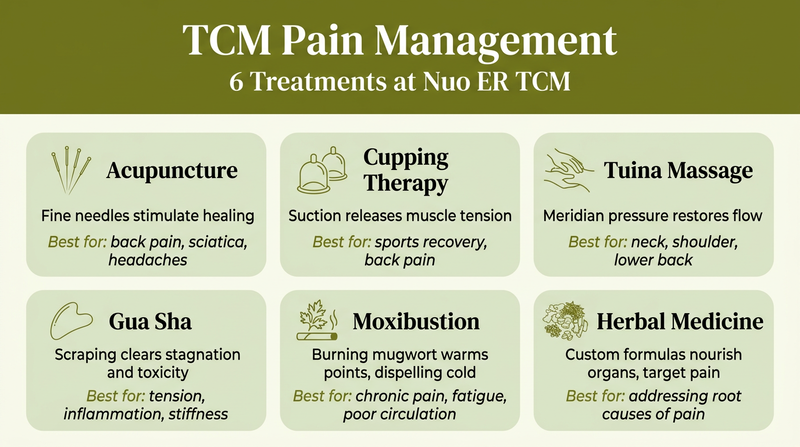
The only time we can give you the right TCM pain management treatment is after a thorough assessment of your constitution, pain patterns, and lifestyle.
We suggest the following TCM treatments to ensure we address the root cause of your pain.
Here’s how each TCM pain management treatment works:
Acupuncture
Acupuncture is a well-researched treatment in Traditional Chinese Medicine. It involves inserting ultra-fine, sterile needles into specific acupressure points along the body’s meridian channels or the pathways through which Qi and blood flow.
When these points are stimulated, the body releases endorphins, reduces inflammation, and improves blood circulation to the affected area.
From a TCM perspective, acupuncture works by clearing Qi blockages that are causing pain. From a modern clinical perspective, it modulates pain signals in the central nervous system and promotes tissue healing.
Can support: Back pain, neck pain, sciatica, headaches, osteoarthritis
Cupping Therapy
Cupping therapy involves placing cups on the skin, using heat or suction to create a vacuum. This suction pulls blood to the surface of targeted areas, breaking up stagnant blood and deeply held muscle tension that manual pressure alone cannot always reach.
In TCM, pain at a fixed location is often a sign of blood stasis, meaning the blood is stagnant and no longer moving freely through the body’s channels.
Cupping directly addresses this by drawing fresh blood into the area, flushing out metabolic waste, and kick-starting the body’s natural repair process. The result is reduced inflammation, loosened muscle tissue, and noticeably improved circulation.
Note: In wet cupping, some studies suggest that the blood drawn may contain higher concentrations of metabolic byproducts — such as uric acid and urea — compared to regular venous blood, which may support the body’s natural clearance processes. In dry cupping, the suction mechanism stimulates local blood flow and circulation, supporting the body’s natural healing process.
Can support: Chronic back pain, sports recovery, deep muscle tension
Tuina Massage
Tuina, meaning “push and grasp”, is a therapeutic massage technique developed alongside acupuncture over more than 2,000 years. Unlike conventional massage, which focuses primarily on muscle relaxation, Tuina uses precise pressure along the body’s meridian lines and acupressure points to restore the flow of Qi and blood.
Your physician uses a combination of kneading, rolling, pressing, and stretching techniques tailored to your specific pain pattern. This releases muscle knots, improves joint mobility, and restores normal blood flow to areas deprived of nourishment.
Tuina is particularly effective for structural pain caused by poor posture, repetitive strain, and sports injuries.
Can support: Neck stiffness, frozen shoulder, lower back pain, sports injuries
Gua Sha
Gua Sha involves using a smooth-edged tool to deliver firm, repeated strokes across the skin’s surface. While it may look intense, it is a controlled, targeted technique that works beneath the surface to address stagnant Qi and poor circulation in soft tissues.
The scraping action stimulates blood flow and brings stagnant blood to the surface. This process triggers a biochemical cascade that reduces pro-inflammatory cytokines and activates the body’s natural healing response[4].
Can support: Chronic pain, muscle tightness, poor circulation
Note: Redness on the skin may appear right after treatment, but it will subside within a day or two.
Moxibustion
Moxibustion uses the gentle, sustained heat of burning dried mugwort to warm the meridians from within. Unlike surface-level heat packs, the heat from moxibustion penetrates deeply into the tissue, expelling cold and damp from the body’s channels and restoring the free flow of Qi and blood.
In TCM, certain types of pain are caused or worsened by cold. Moxibustion directly counteracts this by warming the affected channels and stimulating circulation in areas where cold has caused stagnation.
Can support: Cold-related joint pain, lower back pain, arthritis, knee pain
Chinese Herbal Medicine
Chinese herbal medicine takes the whole-body approach one step further by addressing pain from the inside out. After assessing your body constitution, your physician prescribes a personalised herbal formula designed to target the root cause of your pain rather than just suppress the symptom.
Classical TCM herbal formulas used in pain management are selected based on their traditional properties and individual constitution. They are not generic supplements but carefully formulated combinations built around your individual imbalance pattern.
For external support, ask your physician about topical herbal options that can be used alongside your treatment plan.
Can support: Internal imbalances, inflammation, blood deficiency, joint pain
What Chronic Pain Does to Your Life
Chronic pain is rarely just physical. When pain persists, it creates a ripple effect across your entire quality of life:
- Sleep disrupted: Pain interrupts deep sleep cycles, slowing the body’s natural overnight recovery.
- Mental health affected: Anxiety, low mood, and irritability are common companions of persistent pain.
- Productivity reduced: Difficulty concentrating and reduced energy affect work performance and daily function.
- Quality of life can diminish: Relationships, social engagement, and overall vitality can be significantly affected over time.
Restoring Qi and blood harmony through TCM not only reduces pain but also promotes overall well-being. It supports better sleep, emotional balance, and sustained energy, addressing all four dimensions simultaneously.
What to Expect at Your First Nuo ER Appointment
Many people hesitate to try TCM because they are unsure what happens. Here is what a visit to our clinic looks like:
- We Listen First: Your physician assesses your health through pulse and tongue diagnosis, reviews your pain history, lifestyle, and emotional health. No two assessments are the same.
- We Find the Root Cause: Your physician identifies whether your pain stems from Qi stagnation, blood stasis, or deficiency, and which meridian pathways are involved.
- You Get a Plan Built for You: A tailored combination of therapies is recommended. As a general rule, some patients with acute conditions often notice improvement within a few sessions, while those with chronic conditions may require a longer course. Your physician will advise on a personalised treatment timeline.
Our clinic is staffed by TCMPB-registered TCM physicians and is located at 1 Tras Link, #02-02. It is just 4 minutes from Tanjong Pagar MRT Exit J, and open daily from 10 AM to 9 PM.
Lifestyle Changes That Support Your Recovery
TCM treatment works best when your daily habits support it. Keep moving. Even gentle walking or Tai Chi can help prevent Qi stagnation and ease back pain. Correct your posture at your desk, stretch regularly, and limit direct airflow from the air conditioner on painful joints. Watch your diet: anti-inflammatory foods like ginger and turmeric support Qi flow, while processed and cold foods slow recovery.
And do not underestimate stress. Managing it through rest and breathing exercises is just as important as any physical adjustment. Small, consistent changes between sessions make a significant difference to long-term relief.
Frequently Asked Questions About TCM Pain Management
Is TCM effective for chronic pain?
Yes. Acupuncture is supported by clinical research, including multiple meta-analyses of randomised controlled trials, as an effective option for chronic pain management. If you want to know more about it, read more about it here.
How many sessions will I need?
It depends on your condition and severity. Some patients with acute conditions report noticeable changes within a few sessions, while those with chronic conditions may require a longer course of treatment. Your physician will discuss a personalised timeline during your consultation.
Can TCM be used alongside physiotherapy or Western medicine?
Yes, and we often recommend. TCM works well as a complementary medicine alongside conventional care. Many patients find that combining TCM with physiotherapy or medication produces faster and longer-lasting results than either approach alone. Always inform all your healthcare providers of your full treatment plan.
Is acupuncture painful?
Acupuncture uses ultra-fine, sterile needles that cause minimal discomfort. Most patients experience mild tingling or a dull sensation at the acupoint. Many describe the overall experience as deeply relaxing. Our physicians adjust needle depth and technique to your comfort level throughout the session.
Is treatment at Nuo ER covered by Medisave or insurance?
Please check with us directly on applicable insurance coverage. Medisave is not applicable for treatments at our clinic.
TCM Pain Management Treatments for Your Pain
TCM pain management is natural and non-invasive, with minimal side effects when delivered by registered practitioners. However, if you are in the following groups below, we recommend that you consult your physician before beginning treatment:
- Pregnant women (certain acupuncture points and herbs are contraindicated)
- Individuals on blood-thinning medication or anti-seizure drugs
- Those with hypertension, cancer, or liver/kidney disease
A thorough assessment at your first visit ensures your treatment plan is both safe and appropriately tailored. Our physicians will always review your full health history before recommending any therapy.
Ready to take a different approach to managing your pain?
Nuo ER TCM’s registered TCM physicians at Tanjong Pagar offer personalised assessments tailored to your pain pattern, constitution, and lifestyle. Take your first step toward lasting relief today.
Book an Appointment via WhatsApp or call us: +65 6881 9950
References
- Yeo SN, Tay KH (2009). Pain prevalence in Singapore. Annals Academy of Medicine Singapore, 38(11), 937–941. https://annals.edu.sg/pain-prevalence-in-singapore/
- Vickers AJ et al. (2012). Acupuncture for Chronic Pain: Individual Patient Data Meta-Analysis. Archives of Internal Medicine. https://pmc.ncbi.nlm.nih.gov/articles/PMC3658605/
- Li et al. (2025). Comparative efficacy of acupuncture for chronic low back pain: A network meta-analysis. ScienceDirect. https://www.sciencedirect.com/science/article/pii/S2405844025015130
- Wang Yun et al., 2021, “Exploring scraping therapy: Contemporary views on an ancient treatment https://pmc.ncbi.nlm.nih.gov/articles/PMC8483130/