
- Key Takeaways
- What is TCM Prenatal Massage and How Is It Different?
- First Trimester (Weeks 1–12): Proceed with Care
- Second Trimester (Weeks 13–27): The Optimal Window
- Third Trimester (Weeks 28–40): Preparation and Labour Readiness
- Important TCM Prenatal Massage Safety Considerations
- What to Expect at Your First TCM Prenatal Massage Session
- Frequently Asked Questions
- Ready to Experience TCM Prenatal Massage?
Pregnancy is one of the most transformative experiences a woman’s body undertakes — and TCM prenatal massage is not a one-size-fits-all treatment.
What expectant mothers need in the first trimester is entirely different from what their bodies require in the third.
At Nuo ER TCM, our approach to prenatal care evolves with your pregnancy stage, symptoms, and individual constitution, as every pregnancy journey is unique in traditional Chinese medicine.
Key Takeaways
- First trimester (Weeks 1–12): Proceed with care. Sessions address morning sickness, fatigue, and mood swings.
- Second trimester (Weeks 13–27): The optimal window to begin prenatal massage. Tuina massage targets muscle tension, pelvic pain, and swelling as the body stabilises.
- Third trimester (Weeks 28–40): Preparation mode. Focus shifts to optimal fetal positioning, labour readiness, and easing mounting physical discomfort.
What is TCM Prenatal Massage and How Is It Different?
Prenatal massage in a Western context targets relaxation and surface muscle tension. TCM prenatal massage works differently.
From the TCM perspective, vital energy (or Qi) flows through meridian pathways throughout the body. During pregnancy, Qi flow and blood circulation are redirected to nourish the developing baby, creating imbalances that surface as common pregnancy symptoms: nausea, fatigue, pelvic pain, swelling, and poor sleep quality.
In Traditional Chinese Medicine, the therapeutic massage is called the Prenatal tuina. It uses:
- gentle pressure
- gentle strokes
- targeted acupressure to regulate Qi flow, support blood flow, and restore balance
This holistic approach to pregnancy care reflects TCM philosophy of addressing the root cause, not the surface complaint.
Sessions are often complemented by acupuncture, dietary therapy, and Chinese herbal medicine, forming a complete TCM prenatal programme.
TCM prenatal massage works alongside your existing obstetric care.
Note: Expectant mothers with a high-risk pregnancy or medical conditions such as hypertension or placenta praevia should always consult their healthcare providers and TCM physician before proceeding.
First Trimester (Weeks 1–12): Proceed with Care
The first trimester is the most sensitive period of pregnancy. Most practitioners trained in prenatal care recommend waiting until at least 13 weeks before beginning prenatal tuina.
For women with severe morning sickness, anxiety, or extreme fatigue, we suggest having a carefully managed session earlier, but only under the direct supervision of a qualified TCM physician and only after receiving medical clearance from your obstetrician or gynaecologist.
| Focus Area | Approach | Goal |
| Nausea / Morning sickness | Gentle acupressure at PC6 (Pericardium 6, inner wrist) | Calm the Stomach; reduce nausea |
| Fatigue | Light meridian work on the Spleen and Stomach channels | Strengthen Qi; support relaxation |
| Mood & anxiety | Gentle work along the Liver meridian | Reduce stress hormones; smooth Liver Qi |
| Sleep difficulties | Calming acupressure at HT7 (Heart 7) | Improve restful sleep and sleep quality |
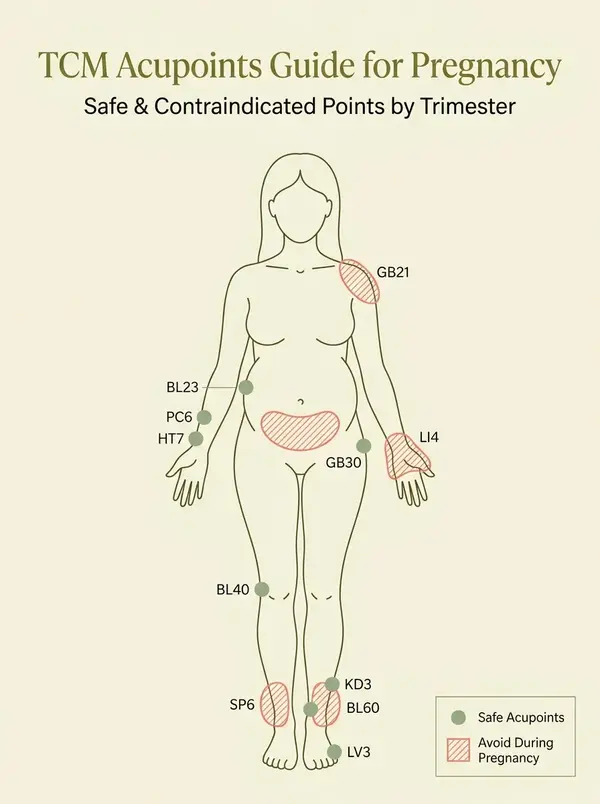
Certain acupuncture points, including SP6, LI4, and BL60, are strictly off-limits, as stimulating them may trigger uterine contractions or increase miscarriage risk. A full list of contraindications is in the Safety section below.
Second Trimester (Weeks 13–27): The Optimal Window
By week 13, miscarriage risk drops significantly. Pregnant women can confidently begin prenatal massage. Many of our clients choose to start prenatal massage at this point precisely because they experience the common pregnancy discomforts, such as:
- lower back pain
- pelvic pain
- hip pain
- leg cramps
- sleep difficulties
- mood swings
During our sessions, we use gentle techniques and massage techniques in a side-lying position, focusing on enhancing blood flow along the Bladder, Gallbladder, and Kidney meridians while promoting relaxation and easing musculoskeletal discomfort.
Recommended frequency: Once every two weeks, but we adjusted it to your condition.
| Symptom | Meridian / Acupoint Focus | TCM Goal |
| Lower back pain | Bladder meridian (BL23, BL40) | Strengthen Kidney Qi; relieve back tension |
| Pelvic pain/hip pain | Gallbladder meridian (GB30, GB34) | Move stagnant Qi; relax hip musculature |
| Leg cramps | Kidney and Spleen meridians (KD3) | Nourish Blood; improve circulation |
| Swelling / oedema | Spleen and Stomach meridians | Resolve Dampness; support fluid metabolism |
| Anxiety/mood swings | Liver and Heart meridians (LV3, HT7) | Smooth Liver Qi; calm the Shen (mind) |
*SP6 is contraindicated in some TCM schools during pregnancy. Always confirm with your TCM physician before treatment.
The second trimester is also an ideal time to explore complementary TCM treatments. At Nuo ER TCM, we also suggest our expecting mothers undergo acupuncture treatment for pain management, dietary therapy for nutritional support, and Chinese herbal medicine under physician supervision.
In essence, these treatments can form a valuable and well-integrated part of a personalised prenatal care plan.
Third Trimester (Weeks 28–40): Preparation and Labour Readiness
As you enter the third trimester, TCM prenatal massage shifts from managing pregnancy discomfort to preparing the body and mind for birth.
Here’s what TCM Prenatal massage does for your body during this stage:
- Gentle strokes along the back, hips, and legs relieve accumulated muscle tension
- Targeted acupressure addresses leg cramps and hip pain
- Circulation work reduces oedema and supports blood circulation to the lower limbs
- Calming meridian work eases stress hormones, supports emotional well-being, and improves sleep quality
- Typically recommended from 34 weeks’ gestation, within a 34–36 week window, under direct physician supervision.
Note: Clinical practice varies; your TCM physician and gynaecologist should jointly advise timing.
Recommended frequency: Once weekly. After 37 weeks, certain acupuncture points can trigger preterm labour, so we only proceed with the guidance of the patient’s gynaecologist.
Important TCM Prenatal Massage Safety Considerations
TCM prenatal massage is generally safe in the second and third trimesters when performed by practitioners trained in prenatal care. However, it is not appropriate for everyone.
Seek medical clearance if you have a history of miscarriage, a high-risk pregnancy diagnosis, placenta praevia or abruption, abnormal bleeding, hypertension, DVT, or gestational diabetes with complications.
Also, take note of acupuncture points and areas contraindicated during pregnancy:
| Point | Chinese Name | Location | Why Contraindicated | Timing Guidance |
| SP6 | 三阴交 Sānyīnjiāo | Inner ankle | Stimulates uterine contractions | Avoid throughout pregnancy |
| LI4 | 合谷 Hégǔ | Thumb/index finger webbing | Increases uterine contractility | Avoid throughout pregnancy |
| BL60 | 昆仑 Kūnlún | Outer ankle / Achilles | Moves Qi and Blood downward | Avoid throughout pregnancy |
| BL67 | 至阴 Zhìyīn | Little toenail (outer) | Uterine stimulation | Therapeutic use only at 32–36 weeks for breech, under physician supervision |
| GB21 | 肩井 Jiānjǐng | Mid-shoulder | Strong descending action; can stimulate labour | Avoid throughout pregnancy |
| LU7 | 列缺 Lièquē | Inner wrist (radial) | Opens Conception Vessel; influences uterine function | use with caution |
| CV3–CV7 | 关元 Guānyuán (CV4) | Lower abdomen, midline | Direct proximity to the uterus | Avoid throughout pregnancy |
| BL27–34 | 膀胱经骶骨区 | Sacral region | Activates uterine/cervical Bladder pathways | Avoid throughout pregnancy |
| CV12 | 中脘 Zhōngwǎn | Upper abdomen | Safe for nausea support in early pregnancy only | Generally safe throughout pregnancy for upper digestive and nausea support; apply with light pressure only. Use under practitioner guidance. |
| ST12 | 缺盆 Quēpén | Supraclavicular fossa, above the midpoint of the clavicle | Strong descending action on Qi across five converging Yang channels (Stomach, Large Intestine, Small Intestine, Triple Burner, Gallbladder); classical texts explicitly contraindicate stimulation during pregnancy | Avoid throughout pregnancy |
| ST36 | 足三里 Zúsānlǐ | Below the outer knee | Strong tonifying point | Generally safe with a qualified, moderate application |
Source: NIH The Safety Of Obstetric Acupuncture: Forbidden Points Revisited
For educational reference only. Never self-apply pressure to contraindicated points.
We advise you to verify that your TCM practitioner is registered with the TCMPB via the MOH Professional Registration System for added safety.
What to Expect at Your First TCM Prenatal Massage Session
Your prenatal journey with TCM support begins not at the table, but with a consultation. Your TCM physician will review your pregnancy symptoms, pregnancy week, and body constitution, and whether you tend toward Qi deficiency, Blood deficiency, or Dampness.
This assessment determines which massage techniques and meridian focus are appropriate for your specific pregnancy stage.
Here are things to expect and be prepared for:
- You will then be positioned in the side-lying position, supported by pillows.
- Loose, comfortable clothing is ideal.
- The session lasts 60 to 90 minutes and combines tuina massage strokes and acupressure.
- You may feel gentle pressure, mild warmth, or a subtle traveling sensation along the meridians, which are all normal signs that the body’s Qi flow is responding.
- After your session, we advise you to rest for 30 minutes, drink warm water, and avoid strenuous activity.
- Cold drinks are discouraged. In TCM philosophy, cold is believed to contract the meridians and slows the Qi flow that the session has just encouraged.
Frequently Asked Questions
When is it safe to start TCM prenatal massage in Singapore?
For massage in Singapore’s TCM clinics, the standard recommendation is to wait until at least 13 weeks. The first trimester carries the highest miscarriage risk, and stimulating certain meridians early can compromise maternal health. Always seek clearance from a registered TCM physician first.
How long is a session, and how often should I go?
Sessions run 60 to 90 minutes. For a healthy pregnancy, we suggest fortnightly sessions in the second trimester, increasing to weekly in the third trimester. Your TCM practitioner will adjust based on your constitution and the level of pregnancy discomfort.
What is the difference between prenatal tuina and a spa prenatal massage?
A spa prenatal massage focuses on surface relaxation. Prenatal tuina works along meridian pathways to address root imbalances affecting pregnancy health, delivering outcomes including improved blood flow, reduced swelling, and better emotional well-being that gentle pressure alone cannot achieve.
Can I combine TCM prenatal massage with other approaches?
Yes. Prenatal yoga builds strength between sessions. Acupuncture treatment addresses deeper imbalances. Dietary therapy and Chinese herbal medicine reinforce the effects of massage. Together, these TCM treatments form a holistic approach to pregnancy care that supports both you and your developing baby.
What should I wear?
Loose, comfortable clothing is ideal. You will not need to fully undress. Avoid jewellery around the ankles and wrists, as these areas contain key acupuncture points your TCM practitioner will need to access.
Ready to Experience TCM Prenatal Massage?
Whether you are navigating morning sickness in the early weeks, managing pelvic pain mid-pregnancy, or preparing your body for birth in the final stretch, TCM prenatal massage may support your comfort, sleep quality, and emotional well-being — experiences that vary from one pregnancy to another.
Our TCM support covers pregnant women at every stage of pregnancy, including postnatal massage to support your recovery after birth.
Book a consultation with our team and begin a prenatal wellness journey with support tailored to you and your baby.
This article is for educational purposes only. Please consult a registered TCM physician before commencing any prenatal treatment
References
- Cochrane Database — Moxibustion for correction of breech presentation
- MOH Singapore — TCM Practitioners Board Registration
- PC6 nausea evidence → NCBI NBK68275
- HT7 sleep in pregnancy → PubMed 26896071
- Acupuncture for pregnancy-related low back pain → PMC10411702
- Safety of acupuncture in pregnancy / forbidden points → PMC4680134